How Second Innings of Trump Administration Affects Immigration Dynamics
US’s political landscape has been ever-evolving. With government changes, the shift in focus areas and ideations are pretty visible. Post Biden’s administration, the interest areas have varied and prominent changes have been suggested since then. This blog investigates what has changed, immigration dynamics shift, ICE’s role in this and more.
The second Trump administration has sharply intensified immigration enforcement with a clear pivot toward worksite raids, I‑9 audits, and a tougher, security‑driven compliance culture that directly affects how employers hire, verify, and retain workers in 2025 and beyond.
This “second innings” is defined by expanded ICE authority, new funding through the One Big Beautiful Bill Act (OBBBA), and updated Form I‑9 rules that raise the stakes for employer mistakes.
Reflecting on transition from ‘Biden’ to ‘Trump’
Under Biden, ICE was instructed to scale back large, public workplace raids and focus on narrower enforcement actions, particularly against serious criminals and recent border crossers. In Trump’s second term, that posture has reversed, with the administration openly embracing a proactive strategy that brings back broad worksite operations and visible immigration crackdowns as central policy tools.
The first 100 days of Trump’s return saw a flurry of immigration‑related executive actions, many at a pace far higher than his first term, expanding the use of detention, removal, and coordinated actions across agencies such as DHS, ICE, and even some Department of Justice divisions. This shift has created a more unpredictable enforcement environment for both immigrants and employers, where no sector or locality can assume it is off‑limits.
OBBBA: Funding the New Enforcement Machine
The One Big Beautiful Bill Act (OBBBA)is a budget reconciliation bill comprised of $170B budget to be used for next 4 years to improve immigration enforcement and border security. Out of $170B, $45B is set to be for ICE and $30B out which will be used to onboard more enforcement officials for better operations. Another $46B to be used for rigid border wall constructions. Despite effective attention, 3.8M cases concerning immigration issues are still pending. the objective of OBBBA is to improve the functioning rather than to reform.
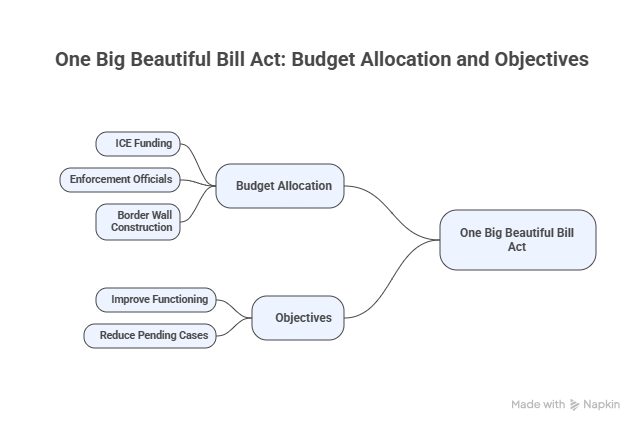
The One Big Beautiful Bill Act (OBBBA) has become the financial engine behind this enforcement surge, channeling billions of dollars into detention, removal, and staffing for ICE. Under OBBBA, ICE has funding to expand detention capacity to nearly 100,000 beds and to dramatically grow its workforce, including deportation officers and support staff.
This influx means:
- More workplace operations and I‑9 audits, especially in sectors like agriculture, construction, hospitality, and food processing that traditionally rely on immigrant labor.
- Greater use of technology and partnerships with state and local agencies to identify and apprehend people deemed removable, and to scrutinize employer practices more closely.
For employers, OBBBA effectively transforms compliance from a “good to have” into a survival requirement: failure to maintain clean I‑9 records and hiring processes can now trigger swift, well‑resourced investigations.
New Form I‑9: Technical Changes
The 2025 edition of Form I‑9, effective from January 20, 2025 and valid through 2027, introduced several targeted but meaningful changes that affect how employers document work authorization. Key updates include:
- Renaming the fourth checkbox in Section 1 from “A noncitizen authorized to work” to “An alien authorized to work,” aligning I‑9 terminology with the administration’s preferred language.
- Revising descriptions of certain List B identity documents, such as driver’s licenses and government IDs, to specify that they must list an individual’s sex, not gender, and updating privacy notices and statutory references in the instructions.
- Employers are expected to start using the new form promptly, even though an earlier 2023 version remains technically acceptable until its stated expiration date, particularly where electronic systems require time to be updated. For E‑Verify users, the citizenship status options have already been aligned to the new “alien authorized to work” terminology, which means inconsistency between the form and electronic record can trigger additional scrutiny.
In conclusion, this phase of U.S. immigration policy, the Trump administration’s second term has turned worksites into front‑line enforcement arenas, with Form I‑9 and employer practices at the center of the story. For organizations, proactive compliance, disciplined documentation, and well‑practiced response protocols are no longer optional; they are essential tools for navigating the heightened immigration dynamics of 2025.

The Affirmative Action Plan

Laws Protecting Older People from Age Discrimination in the Workplace

Employee vs Independent Contractor

Get The Best of The National Labor Relations Act of 1935

EEOC- Striving towards a Better Workplace